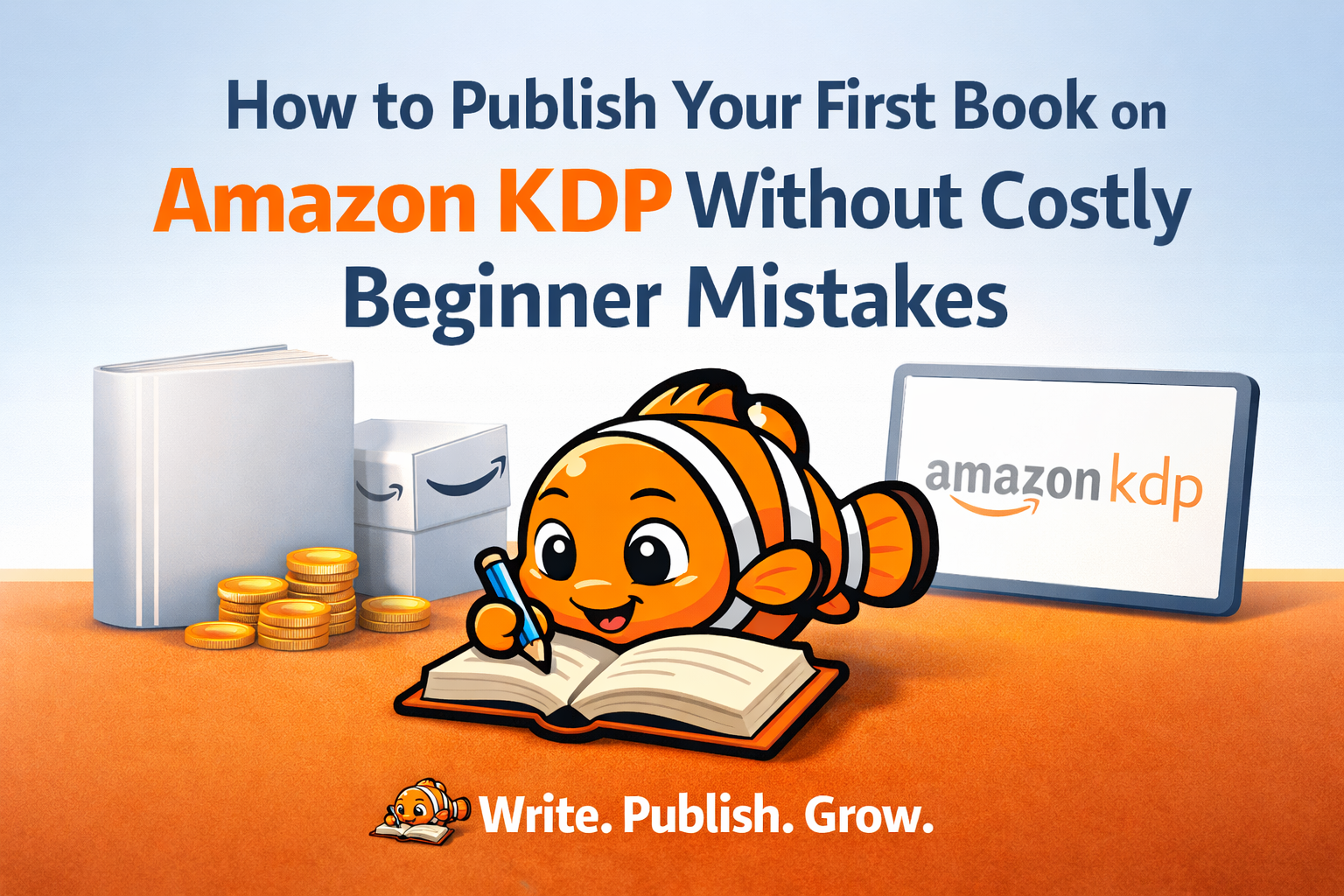
How to Publish Your First Book on Amazon KDP Without Costly Beginner Mistakes
For many writers, publishing is the most intimidating part of the entire process. Writing feels creative. Editing feels demanding but familiar. Publishing, however, feels technical, opaque, and full of ways to get things wrong.
Amazon KDP is not difficult to use, but it is very easy to misunderstand. Most frustration around self-publishing does not come from the platform itself, but from unrealistic expectations, rushed decisions, and a lack of clarity about what KDP actually does.
This guide is here to give you that clarity.
What Amazon KDP actually is (and what it isn’t)
Amazon KDP is a distribution platform. It is not a publisher, an editor, or a marketing service. It allows you to upload your book, choose how it appears on Amazon, and earn royalties when copies sell.
KDP will not improve your manuscript.
It will not fix weak covers.
It will not automatically find readers for you.
What it will do is make your book available worldwide, print copies on demand, handle delivery, and pay you a higher royalty than most traditional publishing contracts.
Most problems new authors have with KDP come from treating it like a magic button rather than a tool.
Understanding formats before you publish
One of the most common beginner mistakes is trying to do everything at once. Ebook, paperback, hardback, maybe even audiobook, all launched together. This usually creates more problems than it solves.
An ebook is often the best place to start. It is cheaper for readers, faster to update if you spot an issue, and easier to experiment with pricing and descriptions.
Paperback editions are excellent, but they require proper formatting, cover sizing, and proofing. A single error can affect the reader experience, and print mistakes are far more frustrating than ebook ones.
Hardbacks are best treated as a later addition unless your genre strongly supports them. They look professional, but they rarely drive early sales for new authors.
There is no rule that says you must publish every format at once. In fact, staggering releases often gives you more control and fewer headaches.
Categories and keywords: where books are actually found
Categories and keywords are not decoration. They determine where your book appears and who sees it.
Many beginners choose categories based on what sounds impressive rather than where their book actually belongs. Broad categories may feel safer, but they also put your book in direct competition with established titles that have years of momentum.
It is often better to choose narrower, more specific categories where your book genuinely fits. This gives your book a chance to be visible rather than buried.
Keywords work in a similar way. They are not about stuffing as many phrases as possible into a box. They are about helping Amazon understand who your book is for. Clear, relevant phrases will always outperform vague or misleading ones.
If your categories and keywords are wrong, even a good book can disappear quietly.
Covers that sell and covers that don’t
A cover does not need to be beautiful. It needs to be effective.
Effective covers communicate genre instantly. A reader should know, at a glance and at thumbnail size, what kind of book they are looking at. When covers fail, it is usually because they are too generic, too busy, or trying to appeal to everyone.
DIY covers can work, but only if they follow genre expectations. Paying for a cover is often worth it, but only if the designer understands your market. A technically impressive cover that does not match genre conventions will actively hurt sales.
Your cover is not about expressing yourself. It is about signalling to the right reader that this book is for them.
ISBNs explained without confusion
ISBNs cause unnecessary anxiety for new authors.
Amazon will offer you a free ISBN for paperback and hardback editions. For most self-published authors, especially early on, this is perfectly acceptable. It allows you to publish without upfront cost and without any impact on sales within Amazon.
Buying your own ISBN gives you more control over publisher listing and distribution outside Amazon. This matters more if you plan to publish widely, work with bookstores, or build a long-term publishing imprint.
It is worth noting that authors in Canada can obtain ISBNs for free through their national system, which removes this cost entirely.
For many first-time authors, the free ISBN is not a mistake. It is simply a practical choice.
The mistakes that cost authors the most time and money
Publishing too early is the biggest one. A book that is not properly edited will collect poor reviews that are very difficult to recover from.
Constantly changing metadata is another. Tweaking descriptions and categories every few days resets Amazon’s understanding of your book and prevents it from settling.
Expecting instant sales is a quiet killer of motivation. Silence after launch is normal. Momentum builds slowly, especially for first books.
Advertising is often treated as a rescue strategy rather than a tool. Ads amplify what already works. They do not fix weak books, unclear covers, or poor positioning.
What happens after you click “Publish”
Once your book is live, the work is not over, but neither should it become obsessive.
Early sales are unpredictable. Some books move quietly for months before finding readers. Others spike briefly and then settle. Both are normal.
The real goal of your first publication is not income. It is experience. Every book teaches you how readers respond, what works in your genre, and where you can improve next time.
Publishing one book puts you ahead of most writers. Publishing a second puts you ahead of most authors.
Where to go next
If you are still writing or editing, return to the Editing & Manuscript Prep section and make sure your book is genuinely ready.
If your book is published or close to it, head to Marketing & Momentum to understand how books actually gain traction over time.
If you want feedback on your opening pages, structure, or blurb, visit Manuscript Critiques and submit your work as a member.
Publishing is not about perfection. It is about doing the right things in the right order. That is exactly what this membership is here to help you do.